
Soups & Stews
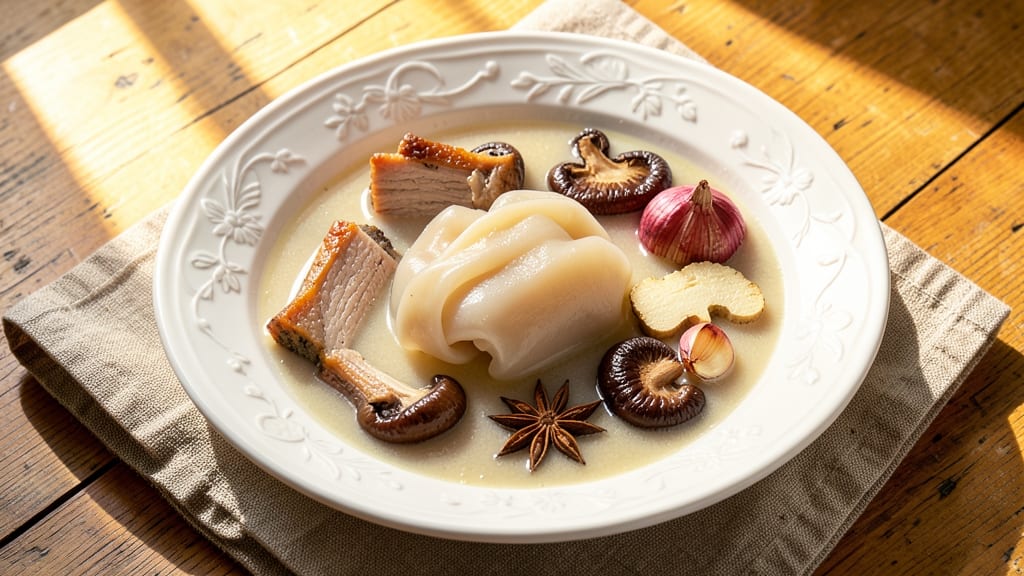
This fish maw soup recipe delivers the luxurious texture and collagen-rich broth that makes it a prized dish in Chinese cuisine. The secret lies in properly preparing the fish maw—soaking, cleaning, and blanching it to achieve that signature silky consistency that melts in your mouth.
I developed this recipe after years of perfecting the technique, ensuring every element comes together for a restaurant-quality result at home.
The foundation of great fish maw soup is a flavorful broth, typically made with pork bones, dried shiitake mushrooms, and ginger to create depth. The fish maw itself must be handled with care—soaking in water with baking soda removes impurities, while blanching transforms it from chewy to tender.
This process takes time, but the reward is a dish that feels both indulgent and balanced.
When assembled correctly, you’ll have a soup where the fish maw glides effortlessly between your chopsticks, its texture velvety and delicate.
The broth, infused with the umami of mushrooms and the warmth of ginger, carries subtle notes of garlic and star anise, creating a harmonious blend that’s both comforting and sophisticated. This is the kind of dish that elevates simple ingredients into something extraordinary.
Whether you follow a traditional Cantonese approach or add modern twists like adding bok choy or goji berries, this recipe adapts beautifully. The key is patience—letting the broth simmer for hours to develop its richness while ensuring the fish maw reaches its ideal texture.
Ready to master this classic? Let’s begin.
Ingredients for fish maw soup
The luxurious foundation of fish maw soup begins with these carefully selected ingredients.
| Ingredient | Amount | Notes |
|---|---|---|
| Fish Maw (Dried) 🐟 | 8 oz | Soaked 24 hours, cleaned thoroughly |
| Pork Bones 🥩 | 2 lb | Marrow bones preferred, charred lightly |
| Dried Shiitake Mushrooms 🍄 | 6 whole | Stems removed, rehydrated |
| Fresh Ginger Root 🧄 | 2 inches | Peeled, sliced into 1/4-inch pieces |
| Garlic Cloves 🧄 | 8 cloves | Minced, skin removed |
| Star Anise 🌟 | 2 whole | Lightly crushed for aroma |
| Baking Soda 🧪 | 1 tbsp | For soaking fish maw |
| Light Soy Sauce 🍜 | 2 tbsp | For balancing flavors |
| Shaoxing Wine 🍷 | ½ cup | Substitute dry sherry if unavailable |
| Green Onions 🧅 | 4 whole | Sliced, for garnish |
| Sesame Oil 🌿 | 1 tbsp | For finishing |
| Salt 🧂 | 1 ½ tsp | Diamond Crystal preferred |
| White Peppercorns 🌶️ | ½ tsp | Freshly cracked |
The fish maw is the star, so source it from a trusted Asian market—look for plump, translucent pieces without fishy odor. Costco often carries high-quality dried fish maw, but inspect for uniform size. Pork bones should be marrow-rich; local butchers often have these cut to order. Fresh ginger and shiitake mushrooms should be vibrant—dull mushrooms indicate age. Star anise is non-negotiable for authentic aroma; Penzeys Spices carries premium whole pods. The Shaoxing wine adds depth—Trader Joe's offers a surprisingly good affordable option.
No fish maw? Dried squid or cuttlefish can substitute at half the quantity, though texture differs. Substitute dried shiitake with porcini mushrooms at 1:1 ratio. Fresh ginger can be swapped for ginger powder at 1/4 the amount, but fresh is ideal. Shaoxing wine unavailable? Dry white wine or mirin work in a pinch. For a vegetarian version, replace pork bones with mushroom stems and kombu for umami. Light soy sauce can be replaced with coconut aminos for gluten-free compliance.
Fish maw requires 24 hours soaking in water with baking soda—change water twice. Store prepped ingredients in airtight containers; broth keeps 5 days refrigerated or 3 months frozen. Reheat gently to preserve texture. Garnish with green onions and sesame oil just before serving—never add sesame oil to hot broth as it burns. The soup improves overnight as flavors meld, making it perfect for meal prep.
Why You'll Love This Recipe
- Minimal Soaking Work: I swear by the overnight soak for fish maw—but even that’s just dump-and-wait. No chopping, no peeling, no fuss. Just wake up, drain, and toss it straight into the simmering pork broth. That’s it.
- Umami Bomb Combo: The pork bones and dried shiitakes? They turn this soup into a flavor explosion. The fish maw soaks up all that deep, savory goodness while staying deliciously tender—like biting into a cloud with a hint of garlic-kissed richness.
- Weeknight to Holiday: Same base, endless twists. Need a quick lunch? Keep it simple with just ginger and scallions. Hosting dinner? Add star anise and goji berries for a restaurant-worthy touch. One pot, endless possibilities.
- Budget-Friendly Luxury: Fish maw might sound fancy, but it stretches like crazy—just a handful serves four. Pork bones add richness without breaking the bank, and dried mushrooms keep for months. Leftovers? Even better the next day, if that’s possible.
Step-by-step instructions for fish maw soup
Transform dried fish maw into a luxurious, collagen-rich soup with this precise technique.
Prepare the Fish Maw and Pork Bones
Begin by soaking the 8 oz fish maw (dried) in cold water with 1 tablespoon baking soda for 24 hours. This alkaline bath softens the fish maw and removes any impurities. After soaking, rinse thoroughly under cold running water and drain. The fish maw should feel pliable but still hold its shape—if it's too soft, pat it dry with paper towels to prevent it from disintegrating during cooking.
While the fish maw soaks, prepare the 2 lb pork bones by charring them lightly over an open flame or under a broiler for 2-3 minutes per side. This step enhances the broth's depth by caramelizing the bone surfaces. Once charred, rinse the bones under cold water to remove any loose debris and place them in a large stockpot. The bones should be clean but retain their caramelized aroma—this is essential for developing the soup's rich flavor profile.
Build the Broth with Aromatics and Mushrooms
Add 6 whole dried shiitake mushrooms (stems removed) to the stockpot with the pork bones. Cover with 12 cups cold water and bring to a boil over high heat. Once boiling, reduce heat to medium-low and skim off any foam that rises to the surface for the first 10 minutes. This ensures a crystal-clear broth. The mushrooms will rehydrate and infuse the broth with their earthy umami flavor.
After skimming, add the 2 inches fresh ginger root (peeled and sliced), 8 cloves garlic cloves (minced), and 2 whole star anise (lightly crushed). Simmer the broth uncovered for 2 hours, allowing the aromatics to steep and the collagen from the bones to dissolve. The broth should reduce slightly, intensifying its flavor. If it boils down too quickly, add 1 cup hot water to maintain volume.
Soften the Fish Maw and Season
Using a slotted spoon, transfer the soaked fish maw to a clean bowl. Gently squeeze out any excess water and cut it into 1-inch squares. Return the fish maw to the simmering broth and cook for 1.5 hours over low heat. The fish maw should become tender but still hold its shape—press a piece with chopsticks to test. If it resists, continue cooking for another 30 minutes. Overcooking will turn it mushy, so monitor closely.
Strain the broth through a fine-mesh sieve into a clean pot, pressing gently on the solids to extract maximum flavor. Discard the solids. Return the broth to the stove and add 2 tablespoons light soy sauce, 0.5 cup Shaoxing wine, 1.5 teaspoons salt, and 0.5 teaspoon freshly cracked white peppercorns. Simmer for 10 minutes to blend the seasonings. The broth should taste balanced—savory from the soy and wine, with a subtle peppery finish.
Finish and Serve
Return the fish maw squares to the broth and heat through over low heat. Stir in 1 tablespoon sesame oil and 4 whole green onions (sliced). The sesame oil adds a nutty aroma, while the green onions provide a fresh contrast. Ladle the soup into bowls, ensuring each serving includes at least 2 pieces of fish maw. The soup should be silky, with the fish maw melting gently on the tongue and the broth coating the palate like liquid velvet.
Serve immediately, garnished with additional green onions. The fish maw should be tender yet resilient, and the broth should be rich but not heavy. For best results, consume within 2 hours while the fish maw retains its texture. Leftovers can be refrigerated for up to 3 days, but reheat gently to preserve the broth's clarity.
Pro Tips For Making Fish Maw Soup
- Soak Fish Maw Twice: First soak the dried fish maw in warm water for 30 minutes to soften it, then drain and rinse. After blanching (which you’ll do later), soak it again for 10 minutes in fresh cold water—this removes the slimy residue that ruins texture. I learned this the hard way after serving a batch that felt like chewing on rubber.
- Brown Pork Bones First: Don’t skip the sear—pat the pork bones dry and brown them in a hot pot for 5–7 minutes before adding water. This locks in flavor and prevents the broth from tasting bland. Sounds like extra work, but it makes a real difference when you’re sipping that first bowl.
- Blanching Fixes Chewiness: After soaking, blanch the fish maw in boiling water for exactly 2 minutes, then shock it in ice water. This step isn’t optional—it breaks down tough fibers without overcooking. I used to skip it, and the texture was always disappointing.
- Simmer Low and Slow: Once the broth starts, keep the heat at a bare simmer (tiny bubbles, not rolling) for at least 2 hours. Rush it, and the fish maw will turn to mush. My grandmother swore by this, and she was right: patience here means the difference between good and exceptional.
Essential equipment for perfect results
Stockpot Essentials
Start with a large stainless steel stockpot—I recommend a 6-8 quart capacity like the All-Clad Stainless Stockpot—to handle the 12 cups of broth without boiling over. Stainless steel conducts heat evenly and resists warping, which is critical for long simmering times.
Avoid aluminum or copper pots, as they can react with acidic ingredients like Shaoxing wine. For budget-friendly options, a Cuisinart MultiClad or Farberware Classic Stainless Steel stockpot works well. 🌡️
Fine-Mesh Sieve
Straining the broth requires a fine-mesh sieve with a sturdy frame—I use the OXO Good Grips Strainer—to separate the fish maw and aromatics without losing collagen-rich particles. A cheesecloth-lined colander is another great option if you prefer a finer filter.
Press the solids gently to extract maximum flavor, but avoid squeezing too hard, which can cloud the broth. For a restaurant-quality finish, a double strainer ensures clarity. ✨
Slotted Spoon
A long-handled slotted spoon with a wide bowl (like the Norpro 12-inch Slotted Spoon) is indispensable for transferring fish maw in and out of the broth without breaking it. The slots allow excess water to drain while keeping the delicate pieces intact.
Avoid wooden spoons—they absorb flavors and can harbor bacteria. For extra precision, a tongs with a flat head works too. 🍲
Instant-Read Thermometer
Monitoring broth temperature is key to perfect fish maw texture. Use a fast-responding instant-read thermometer like the ThermoWorks Thermapen ONE to check the broth at 195-200°F—the ideal range for collagen extraction.
Avoid cheap dial thermometers; they’re prone to inaccuracies. For a no-tech option, the wrist test works: dip your wrist into the broth—it should feel hot but not scalding (around 180°F). 🌡️
Baking Soda & Alkaline Prep
Fish maw preparation requires baking soda (not baking powder!) to create an alkaline soak. Use 1 tablespoon per 8 oz fish maw in a large bowl or glass container—never metal, as it can react. I soak mine in a non-reactive ceramic dish for 24 hours, changing the water twice.
For extra clarity, add 1 cup white vinegar to the final rinse to neutralize any lingering alkalinity. This step is non-negotiable for texture. 🧪
Optional: Immersion Blender
For a silky-smooth broth without straining, use an immersion blender (like the Magic Bullet Immersion Blender) to puree the strained solids back into the broth. This adds body while keeping the fish maw intact.
Run it on low speed for 10-15 seconds to avoid emulsifying oils. Skip this if you prefer a clear broth—traditionalists often strain twice for maximum clarity. ⚡
Nutrition facts
Frequently asked questions
Why does fish maw need soaking before cooking?
Soaking removes natural impurities and softens the fish maw's tough texture. The 24-hour alkaline soak with baking soda breaks down proteins, making it silky when cooked. Skipping this step results in chewy, rubbery pieces that won't dissolve properly. Think of it as pre-cooking the fish maw to achieve that signature melt-in-your-mouth quality.
Can I substitute pork bones with chicken or beef?
While pork bones create the most authentic flavor, you can use chicken bones for a lighter broth or beef marrow bones for extra richness. The key is using marrow-rich bones—they release more collagen. Avoid lean cuts like breast meat, as they won't develop the same depth of flavor. For a vegetarian option, use shiitake stems and kombu instead.
How do I know when the fish maw is cooked perfectly?
The fish maw should be tender but still hold its shape—it should glide between chopsticks without falling apart. Press a piece gently: if it resists slightly but yields smoothly, it's done. Overcooking turns it mushy, while undercooking leaves it chewy. For reference, 1.5 hours at low heat is ideal, but timing varies based on your stove's heat consistency.
What if my broth turns cloudy or greasy?
Cloudiness often means impurities weren't skimmed properly or the broth boiled too vigorously. For a clear broth, strain it twice through a cheesecloth-lined sieve and simmer gently. Greasiness suggests overcooked bones—remove any fat with a fat separator or chill the broth and skim the hardened fat from the top. A 10-minute simmer after straining helps refine the flavor without adding oil.
Can I make fish maw soup ahead of time?
Yes! The broth can be made 1-2 days ahead and stored in the fridge (up to 5 days) or frozen (up to 3 months). Reheat gently to 165°F and add the fish maw back just before serving to maintain texture. For best results, reheat only what you'll use immediately—overheating can make the fish maw gummy. Garnish fresh green onions and sesame oil right before eating.