
Soups & Stews
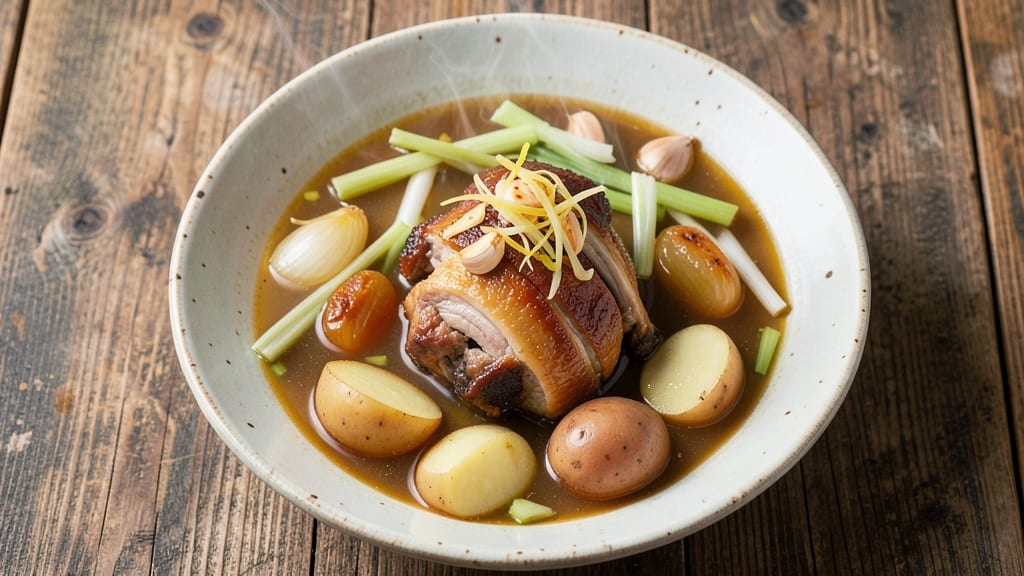
This atama soup recipe brings Filipino comfort food to life with its rich, velvety broth and crisp celery crowns—every spoonful is a celebration of tradition. 🌟 The secret lies in slow-simmering pork or chicken head with aromatic ginger and garlic, transforming tough cuts into tender, flavorful bites that melt in your mouth.
This isn’t just soup; it’s a labor of love, packed with vegetables like potatoes, carrots, and cabbage that soak up the savory broth while keeping their natural sweetness.
The magic happens during the long simmer, where the bones release collagen into the broth, creating a luxuriously thick velouté that coats every ingredient. Crisp celery crowns add a delightful textural contrast, while fresh herbs like parsley or cilantro brighten the dish at the end.
Perfect for family gatherings or special occasions, this recipe delivers restaurant-quality depth with a homemade touch.
What makes this dish truly special is its cultural heritage—atama soup is a staple in Filipino cuisine, often served during holidays and celebrations. The combination of tender meat, hearty vegetables, and aromatic broth makes it a hearty, satisfying meal that warms both body and soul.
Whether you're cooking for a crowd or treating yourself to a comforting bowl, this recipe promises a taste of tradition.
Ready to create this rich, flavorful soup? The process is straightforward, but the reward is unforgettable. Let’s get started—your table (and taste buds) will thank you.
Ingredients for atama soup
Six pounds of aromatic broth, crisp celery crowns, and tender meat—this is Filipino comfort in a bowl.
| Ingredient | Amount | Notes |
|---|---|---|
| Pork or Chicken Head 🐖 | 2 lbs | Freshly cleaned, skin removed |
| Celery Stalk 🧅 | 1 whole | Large, for crisp crowns |
| Yellow Onion 🧅 | 1 whole | Sweet variety preferred |
| Garlic Cloves 🧄 | 6 cloves | Peeled, smashed for aroma |
| Fresh Ginger Root 🌿 | 2 oz | Peeled, sliced into coins |
| Russet Potatoes 🥔 | 2 lbs | Peeled, cut into chunks |
| Green Cabbage 🥬 | 1 small | Whole head, shredded |
| Carrots 🥕 | 4 whole | Large, cut into chunks |
| Fresh Parsley 🌿 | ¼ cup | Chopped, for garnish |
| Fresh Cilantro 🌿 | ¼ cup | Chopped, for garnish |
| Canola Oil 🫒 | ½ cup | For deep-frying celery |
| Salt 🧂 | 2 tsp | Kosher or sea salt |
| Black Peppercorns 🌶️ | 1 tsp | Freshly ground |
| Bay Leaves 🌿 | 2 whole | Dried, for simmering |
| Fish Sauce 🍶 | 1 tbsp | For umami depth |
The pork or chicken head is the heart of this dish—Filipino markets or specialty butchers are your best bet for fresh cuts. Look for heads with intact bones; they release the most collagen during the long simmer. Costco often carries chicken heads in their frozen section, but if you're using pork, the Asian grocery store near you will likely have it. Fresh ginger and garlic are non-negotiable here—their aromatic oils build the soup's signature depth. For the celery crowns, grab the thickest stalks you can find; Trader Joe's usually has perfect ones in their produce section.
No pork or chicken head? Substitute with 2 lbs beef marrow bones or chicken feet—they'll still give you that rich, gelatinous broth. Running low on fish sauce? Soy sauce at half the amount works in a pinch, though it won't have the same umami complexity. The cabbage can be swapped for Napa cabbage or bok choy if you prefer a more delicate texture. For the celery crowns, if you can't find thick stalks, cut regular celery lengthwise into 1/4-inch planks—they'll still crisp beautifully. The potatoes should be waxy (like Yukon Gold) to hold their shape during cooking.
This soup tastes even better the next day as the flavors meld. Store the broth separately in the fridge for up to 5 days—it reheats beautifully. The celery crowns will stay crisp for 2 days if stored in a paper towel-lined container. For a crowd, double the broth and freeze it in 1-cup portions; thaw overnight in the fridge before reheating. The meat can be removed from the bones after cooking, chopped, and stored for 3 days in the fridge or 3 months frozen.
Why You'll Love This Recipe
- One-Pot Magic: I swear by this soup because it’s all in one pot—no chopping boards to clean, no extra pans. The head simmers down while the onions and celery soften, and by the time the ginger and garlic infuse that broth, you’re left with one pot to wash. Honestly, that’s half the battle won.
- Umami Bomb: That pork or chicken head? It’s the secret weapon—rich, gelatinous, and packed with flavor you won’t find in regular broth. Pair it with the sharp bite of fresh ginger and garlic, and you’ve got a soup that’s ridiculously satisfying, like a hug in a bowl.
- Leftovers That Beg: This soup tastes even better the next day. I make a big batch on Sundays, and by Wednesday, it’s the only thing my family will eat. The broth thickens just enough to cling to noodles (if you add them), and the meat stays tender—no dry, sad leftovers here.
- Budget Feast: Using the head means you’re getting way more meat for your money. A single head feeds four, and the bones add depth without costing extra. Between us, it’s the most economical way to make a soup that feels fancy—no fancy ingredients needed.
Step-by-step instructions for atama soup
Transform humble ingredients into a fragrant, velvety broth with crisp celery crowns and layered flavors.
🔥 Step 1: Deep-Fry Celery Crowns to Crisp Perfection
Cut the whole celery stalk into 1-inch thick rounds, keeping the leafy crowns intact. Heat 0.5 cup canola oil in a deep skillet over medium-high heat until it reaches 350°F—test with a thermometer or drop in a tiny piece of celery; it should sizzle immediately. Fry the celery crowns in batches for 2-3 minutes until the edges turn deep golden brown and the celery feels tender when pierced with a knife.
Here's the thing—don't overcrowd the pan or the oil temperature will drop. You want those crowns to stay crisp, not soggy. Drain on paper towels and set aside; they'll stay crispy for up to 30 minutes if kept warm in a 200°F oven. This step is what makes atama soup special—the crunch contrasts beautifully with the silky broth.
🍳 Step 2: Build the Aromatic Base in Two Stages
In a large stockpot, combine the 2 lbs pork or chicken head, 1 whole yellow onion (halved), 6 cloves garlic (smashed), 2 oz fresh ginger root (sliced), 2 lbs russet potatoes (cut into chunks), 1 small green cabbage (shredded), and 4 whole carrots (cut into chunks). Add 2 whole bay leaves, 2 tsp salt, and 1 tsp black peppercorns. Cover with 8 cups cold water—you want enough liquid to submerge everything by at least 2 inches.
Bring to a boil over high heat, then immediately reduce to a gentle simmer. Skim off any foam that rises to the surface for the first 10 minutes—this ensures clarity in your broth. Let it simmer uncovered for 1 hour, stirring occasionally. The broth should reduce slightly, and you'll smell that unmistakable umami depth developing. This is where the magic happens: the collagen in the head melts into the water, creating that signature velouté texture.
🥘 Step 3: Strain and Season the Velouté
After simmering, strain the broth through a fine-mesh sieve into a clean pot, pressing gently on the solids to extract every last drop of flavor. Discard the solids or save them for another use if you're feeling ambitious. Return the strained broth to the pot and bring it back to a gentle simmer. Add 1 tbsp fish sauce and taste—this is where the broth comes alive. The fish sauce should enhance the umami without overpowering; you're aiming for a balance that makes your taste buds sing.
Here's a pro tip: If the broth tastes too mild, add a pinch more salt. If it's too strong, thin it with ½ cup hot water. The consistency should be light but substantial, like a cross between consommé and velouté. Keep it warm over low heat while you prepare the garnishes.
👨🍳 Step 4: Assemble and Garnish for Maximum Impact
Ladle the warm broth into bowls, dividing it evenly among the 6 servings. The crisp celery crowns should go on top of each serving—2-3 crowns per bowl. Sprinkle with 0.25 cup fresh parsley and 0.25 cup fresh cilantro, reserving a little for garnish. The herbs should be finely chopped so they distribute evenly throughout each bite, adding a bright finish to the rich broth.
This is the moment that matters: the contrast between the crisp crowns and the silky broth. Serve immediately while the celery is still crunchy and the broth is steaming. The aroma alone—ginger, garlic, and that deep umami from the fish sauce—will have your guests leaning in for their first sip. For extra drama, add a drizzle of chili oil or a sprinkle of toasted sesame seeds if you're feeling adventurous.
Pro Tips For Making Atama Soup
- BLANCH THE HEAD FIRST: Skip the slow simmer start—drop the whole head (pork or chicken) into boiling water for 3-4 minutes first. This loosens the skin, pulls out blood, and makes the broth clearer later. (Yes, it’ll look alarming, but your soup will taste cleaner.)
- SLICE GINGER THINLY: Forget the matchsticks—shave ginger into paper-thin slices (use a knife, not a grater) and add them whole. They’ll infuse flavor without bitterness and can be fished out later. (I used to over-grate and ruin the broth’s balance.)
- DON’T RUSH THE BROWN: Let the head sear deeply in the pot—10-12 minutes on medium-high—until the bones turn dark brown. This isn’t just for looks; it builds the richest umami base. (I learned this after a pale, weak broth that tasted like nothing.)
- STRAIN TWICE FOR CLARITY: After simmering, strain through a fine-mesh sieve, then a cheesecloth-lined colander. The second pass removes microscopic particles that cloud the broth. (It’s extra work, but the difference in texture is noticeable.)
Regional styles of this atama soup
Filipino Heartland
This dish is a cornerstone of Filipino lugaw (soup) culture, often called "sopa de cabeza" in Spanish-influenced regions. In the Visayas and Luzon areas, pork head is traditional, while chicken head versions dominate in coastal communities where seafood flavors blend into daily meals.
The crisp celery crowns were inspired by Filipino street food techniques—crunchy textures are prized for cutting through rich broths. 🥗
In Manila, you'll find atama soup served at family gatherings, especially during Lenten Fridays when meat dishes are traditionally avoided. The dish evolved from Spanish-influenced caldo recipes but was adapted with local ingredients like fish sauce and ginger, giving it that unmistakable Filipino soul.
The long simmering technique comes from pre-colonial traditions where tough cuts were tenderized through slow cooking.
Chinese-Filipino Fusion
In Binondo, the world's oldest Chinatown, atama soup blends Chinese techniques with Filipino flavors. The celery crowns technique comes from Chinese youtiao (fried dough) culture, where crispy textures are essential.
Many Filipino-Chinese families add star anise or sichuan peppercorns to the broth for a subtle warmth that bridges both cuisines. This fusion is especially popular in Cebu, where Chinese-Filipino communities thrive.
For a fusion twist, try adding 1 tsp five-spice powder to the broth during simmering. The anise notes complement the fish sauce beautifully, while thinly sliced scallions on top add another layer of aroma. This version is common in Manila's Chinatown restaurants, where atama soup is a lunch special. 🌶️
Japanese-Inspired Adaptation
In Okinawa, where Japanese and Filipino culinary traditions intersect, atama soup takes on a lighter profile. The broth is often clarified like Japanese dashi, with kombu seaweed and bonito flakes added alongside the pork head.
The celery crowns are replaced with tempura-fried leeks for a crispier bite. This version is less common but beloved in Davao, where Japanese-Filipino communities settled after WWII.
For this adaptation, simmer the broth with 1 piece kombu and 2 tbsp bonito flakes for 10 minutes before straining. Add 1 tsp mirin to the finished broth for a touch of sweetness that balances the umami.
Garnish with shiso leaves instead of parsley for that distinct Japanese-Filipino flavor profile. 🍵
Modern Filipino Twist
Today's Filipino chefs are putting their own spin on atama soup, often incorporating umami bombs like miso paste or anchovy paste into the broth. Some versions even include pork belly alongside the head for extra richness.
In Baguio, the cooler climate allows for a lighter broth with mountain vegetables like string beans and eggplant added during the final simmer.
For a modern take, add 1 tbsp white miso paste to the simmering broth for 15 minutes before straining. Top with quick-pickled radishes (thinly sliced radishes tossed with rice vinegar and sugar) for a tangy contrast.
This version is popular in Manila's trendy cafes, where atama soup is served as a brunch centerpiece. 💡
Nutrition facts
Frequently asked questions
Can I substitute pork or chicken head with other bones?
Yes! For a similar rich broth, use 2 lbs beef marrow bones or chicken feet—both release collagen beautifully. Avoid chicken wings or drumsticks, as they don't provide the same gelatinous texture. If using beef, add an extra 1 tsp fish sauce to compensate for the milder flavor.
How do I keep the celery crowns crispy longer?
After frying, place them on a wire rack over a baking sheet and keep warm in a 200°F oven for up to 30 minutes. For extended storage, freeze them on a tray first, then transfer to a bag—thaw at room temperature before serving. Pro tip: Re-crisp in the oven for 5 minutes if they lose crunch.
Why does my broth taste bitter?
Bitterness usually comes from overcooking the aromatics (garlic/onion) or skimping on skimming foam. Remove the broth from heat immediately after simmering, then strain through a cheesecloth-lined sieve for extra clarity. If it's still bitter, add 1 tsp sugar or ½ cup coconut milk to balance the flavors.
Can I make atama soup in a slow cooker?
Brown the meat and aromatics in a pan first, then transfer everything to the slow cooker with 8 cups water. Cook on low for 6-8 hours, skimming foam occasionally. The slow cooker's gentle heat makes the broth even more tender and flavorful—perfect for hands-off cooking.
What's the best way to serve atama soup?
Pair it with steamed jasmine rice and a side of sinigang (Filipino sour soup) for a full meal. For extra presentation, serve in individual bowls with crispy crowns on top and garnish with toasted garlic chips or lime wedges. It's especially popular during Lenten Fridays or family gatherings.